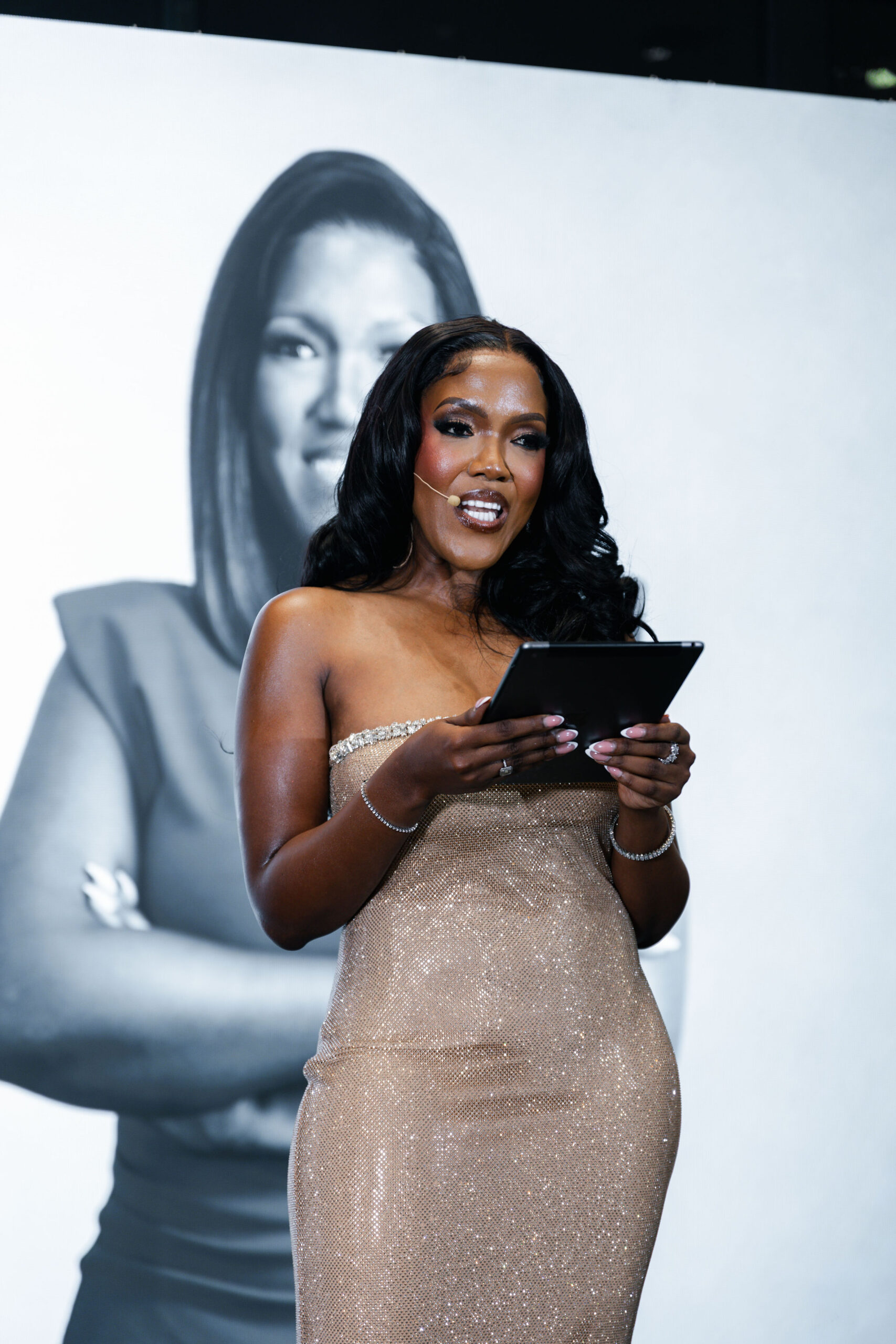
The business development professional and GIBS MBA graduate on finding her voice,
redefining success and building a legacy that reaches beyond
personal achievement.
There is something compelling about a woman who understands that ambition and purpose
need not exist in competition with one another. For Misiwe Xolo, a career spanning
marketing, communications, sales and business development has become about far more
than professional milestones. It is about service, the courage to embrace unfamiliar
opportunities and the responsibility to make the journey a little easier for the women who
follow.
When asked to introduce herself beyond her professional titles and qualifications, Xolo does
not begin with her achievements. Instead, she describes herself as a lover of life, expressing
gratitude to God for the opportunity to live fully in the present moment. It is a revealing
introduction to a woman whose approach to ambition is deeply connected to faith, gratitude
and an understanding that success becomes more meaningful when it extends beyond
oneself.
That perspective has its roots in her upbringing. Xolo credits her maternal grandparents,
whose selfless love and commitment to serving others shaped her understanding of what it
means to contribute to the spaces one occupies. Their example instilled in her a lasting
question: what can I bring to the table? It is a principle that continues to inform the way she
approaches her work, relationships and the opportunities that come her way.
For a woman whose professional life has required her to navigate different industries,
responsibilities and expectations, that grounding has proved invaluable.
Finding Her Voice and Learning to Bet on Herself
Communication, Xolo explains, has always come naturally to her. It is less a skill she
acquired along the way and more a vocation, one that has allowed her to move betweenmarketing, communications, broadcasting, sales and business development with a sense of
purpose.
Her transition into sales, however, was not something she had initially planned. While
working closely with telecoms business leader Megan Nicholas in a personal assistant role,
Xolo’s potential became apparent to someone who would ultimately play an important part in
her career. Nicholas, who has since become a dear friend, challenged her to consider sales.
What began as an unexpected career move quickly became a turning point.
Xolo took to the environment almost immediately and has never looked back.
Yet the transition was not without its doubts. Moving from a personal assistant position into
sales brought a period of imposter syndrome, with Xolo questioning whether she possessed
what it took to succeed. It is a familiar experience for many women who find themselves
stepping into unfamiliar professional territory, particularly when the expectations are high and
the learning curve is steep.
Her response was to embrace the possibility that readiness does not always precede
opportunity.
“Sometimes you need to build the plane while it’s flying,
” she reflects.
The lesson was not that preparation is unimportant, but that waiting until every doubt has
disappeared can mean waiting indefinitely. Xolo learnt to trust that she had been appointed
to an opportunity at that particular time for a reason, while remaining willing to learn, ask
questions and grow into the responsibility.
Having a teachable spirit and remaining curious became essential to her development. So
did the willingness to serve.
Her experience offers a useful reminder to women navigating career changes or considering
opportunities that seem to stretch beyond their current capabilities. Confidence does not
always arrive before the leap. Sometimes it develops through the experience of taking it.

Redefining What Success Looks Like
Over the years, Xolo’s understanding of success has shifted from a more inward-looking
question of what an achievement can do for her to a broader consideration of what she can
contribute to others.
It is a change in perspective that has influenced the way she approaches both professional
accomplishment and disappointment.
Sales, by its nature, comes with measurable expectations. Targets must be met, numbers
must be delivered and performance is often visible in ways that leave little room to hide
when things do not go according to plan. Xolo speaks candidly about the seasons in which
she has missed targets and felt that she had let herself and the business down.
Her response has been to embrace the idea of failing forward.Rather than allowing a setback to become a final judgement on her abilities, she has learnt
to examine what went wrong, take the lesson and determine what needs to change. It is an
approach that recognises the emotional weight of disappointment without allowing it to
become the defining feature of the experience.
For Xolo, contributing to the bigger picture and being of service is a blessing in itself.
Success is no longer measured solely by what she can accumulate or accomplish, but by
the value she brings to the people and organisations around her.
This philosophy is also evident in her understanding of communication and leadership.
Having worked across business strategy and communications, including broadcasting and
serving as a master of ceremonies, she sees effective communication as something that
begins long before a person speaks.
It begins with observation and listening.
To lead, influence and build meaningful relationships, Xolo believes in listening intentionally,
remaining open to different viewpoints and bringing those perspectives into conversations in
ways that enrich the exchange and uplift others. Consideration, she says, communicates
care.
It is an approach to leadership that makes space for people rather than simply expecting
them to make space for authority.
Leadership Begins With People
An experience that left a lasting impression on Xolo was her participation in the CEOx1Day
initiative with PepsiCo South Africa, during which she spent time with the company’s then
chief executive, Riaan Heyl.
Rather than limiting the experience to boardrooms and executive discussions, Heyl took her
into retail environments, factories and manufacturing sites, exposing her to different levels of
the business. The experience broadened her view of how an organisation operates and the
people whose contributions sustain it. She remains in touch with him today.
One lesson, in particular, stayed with her: always put people first.
For Xolo, leadership ultimately comes down to serving others for the greater good. It is a
principle that sits comfortably alongside the values instilled in her by her grandparents and
her belief that professional influence carries a responsibility to others.
It also shapes her understanding of confidence, particularly for women who may feel
pressure to prove themselves in professional environments.
She describes values and beliefs as a personal north star. Knowing who you are at your
core, she believes, makes it easier to navigate external expectations because you have a
clearer understanding of what you bring to a space and what you are prepared to accept.
That clarity also makes it easier to say no.Over time, her relationship with confidence has evolved into something more grounded. She
has learnt to trust herself and to lean into her vocation as a human being first, rather than
allowing professional identity to become the sole measure of her worth.
It is a distinction worth making. Titles may open doors, but a clear sense of self helps
determine which doors are worth walking through.

An MBA With a Legacy in Mind
For Xolo, pursuing a Master of Business Administration at the Gordon Institute of Business
Science (GIBS) was never simply about adding another qualification to her name. It was an
opportunity to create a different legacy for her family.
She was determined to become the first among her late mother’s children to obtain a
master’s degree, with the hope that her achievement would help her siblings see what was
possible for them, too.
The motivation was personal, but the significance extended beyond her own academic
journey. Completing the MBA represented an opportunity to pave a different path for her
bloodline, turning an individual milestone into an example that others in her family could
draw from.
The experience also offered lessons that extended well beyond the classroom. Working
alongside professionals with different personalities, strengths and abilities taught her the
importance of collaborating towards a shared objective, even when people approach
challenges differently.
Her guiding principle in those moments is simple: tackle the ball, not the man.
It is a reminder to focus on the issue rather than making disagreements personal, particularly
when working with people whose perspectives differ from your own. In professional
environments where collaboration is essential, that distinction can make all the difference.
Xolo also received an award in Digital Strategy and Technology Execution, an achievement
she describes as completely unexpected. She enjoyed the module so much that the
recognition came as a welcome surprise.
The subject deepened her thinking about business growth, innovation and the role of
technology in an increasingly complex commercial environment. With artificial intelligence
changing the landscape, she believes business can no longer be approached as a linear
process.
Her most important lesson was the value of simplicity: cutting through the noise, being clear
about what a business will and will not do, and questioning whether assumptions reflect
actual market conditions.
It is an approach that places clarity above complexity and encourages leaders to remain
curious about the realities shaping their industries.For women considering further education while juggling work, family and other
responsibilities, Xolo does not pretend that the journey comes without sacrifice. She
acknowledges that it demands giving up comfort, but believes some ambitions are worth that
exchange.
“Your dreams are valid,
” she says.
It is a message grounded in her own experience. Completing her MBA was not simply a
personal victory; it was a declaration of what she hoped would become possible for those
who came after her.
Moving Beyond Mentorship to Sponsorship
Few aspects of Xolo’s professional outlook are as closely connected to her sense of purpose
as her commitment to developing young women and creating opportunities for others.
She believes that everyone stands on the shoulders of giants in one way or another,
benefiting from the sacrifices, lessons and opportunities created by those who came before.
The responsibility, therefore, is to pay that forward by sharing knowledge, opening doors and
helping the next generation thrive.
For Xolo, true legacy is not confined to what a person achieves for herself. It is also
measured by what she makes possible for others.
This belief informs her view of women’s empowerment, particularly the distinction between
mentorship and sponsorship.
Mentorship has an important place in professional development, offering guidance,
encouragement and the benefit of another person’s experience. But Xolo believes the
conversation must go further.
Many women possess the skills, ideas and capabilities to thrive, yet remain outside the
rooms where their talents could be recognised and put to use. Advice alone cannot always
bridge that gap.
Meaningful support requires women to advocate for one another when they are absent, use
their influence to create opportunities and ensure that talented individuals are introduced to
the people and networks that can help advance their careers.
In other words, support must translate into action.
Her position is straightforward: when women have the power to open a door for someone
else, they should do so.
It is an understanding of empowerment that moves beyond the language of solidarity and
asks what that solidarity looks like in practice. Who is being recommended for the
opportunity? Whose name is being put forward for consideration? Who is being invited into
the room?These are the small but consequential decisions through which professional networks can
become more accessible.
Xolo’s own experience also informs her appreciation of emerging talent. Having been a
finalist in the ICT sector at the Rising Star Awards in 2020, she now serves as a judge for
the awards, a role she has held for the past three years.
served
It is a full-circle experience that allows her to recognise potential from a different perspective.
What stands out to her is a young leader’s ability to identify real-world problems and develop
practical solutions. Theoretical knowledge has its place, but she is particularly drawn to
people who can translate what they know into tangible outcomes.
She also believes young professionals often underestimate their ability simply to begin.
Her advice is to start small, start now and never despise small beginnings.
The reminder is especially relevant in a culture that can make progress appear more
glamorous and immediate than it really is. Not every meaningful idea begins with substantial
resources, a large platform or an impressive title. Sometimes the first step is simply the
decision to try.

Faith, Gratitude and the Quiet Work of Becoming
For a woman who has spent years pursuing professional goals, Xolo’s understanding of
fulfilment is closely tied to gratitude.
As a born-again Christian, she relies on her faith in both the significant moments and the
everyday details of life. It allows her to rest in the belief that God is present in every aspect
of her journey, making room for peace even when there is still more she hopes to achieve.
Gratitude, she explains, keeps her attention on what has already been given rather than
solely on what remains missing. It allows her to begin from a place of enough instead of
anxiety.
It is a perspective that also influences the way she navigates comparison.
Xolo speaks openly about having outgrown the belief that she was not enough, alongside
the habit of comparing her journey with those of others. Reclaiming her story meant learning
to trust the timing of her own life rather than measuring it against someone else’s progress.
That does not mean she believes she has arrived at a finished version of herself.
She is still learning to stretch beyond her comfort zone, both professionally and personally,
and to create the capacity for new challenges. There is, she believes, plenty of room left to
grow.
It is an honest admission from someone whose qualifications and experience might suggest
that she has already reached a place of certainty. Instead, Xolo approaches personal growthas an ongoing process, one that requires the humility to recognise how much remains
possible.
As she looks towards the next chapter of her career, she is particularly interested in board
opportunities and what it would mean to contribute at that level. Just as importantly, she
wants to explore how she can help make board participation feel less daunting for other
women.
The ambition is not simply to occupy a seat, but to help more women see themselves as
capable of taking one.
A Feminine Approach to Authority
Away from business strategy, professional development and leadership, Xolo’s perspective
on personal style offers another glimpse into the woman behind the achievements.
Her aesthetic is distinctly feminine, but she is clear that femininity and authority need not
exist at opposite ends of the spectrum.
She can be soft and strategic, graceful and decisive, without having to sacrifice one quality
to be taken seriously for another. It is a philosophy that extends beyond clothing into the
broader question of how women choose to present themselves and occupy professional
spaces.
One woman whose style and character she admires is Amanda Dambuza, the multitalented
businesswoman and philanthropist. Xolo appreciates her polished, effortless approach to
dressing, particularly her ability to understand her body and dress for it with confidence.
But what resonates most is Dambuza’s generosity and the way she makes space for other
women without making herself the centre of the conversation.
For Xolo, the combination of personal confidence and generosity of spirit is just as
compelling as the clothes themselves.
Her own wardrobe reflects a similarly considered approach. Describing herself as a woman
who is “balling on a budget”
, she rejects the idea that elegance must come with an
extravagant price tag.
“I believe elegance is a skill, not a price tag,
” she says.
Dresses feature prominently in her wardrobe, reflecting her preference for feminine dressing.
She values understanding what suits her body, what lasts and what makes her feel like
herself. The aim is to spend intentionally, look polished and feel put together without being
reckless with money or dressing for applause.
It is an approach that makes personal style less about the labels on a garment and more
about the judgement behind the choice.Her relationship with beauty and presentation has evolved in a similar way. There was a time
when looking polished meant adding another layer, another accessory or another trend in an
effort to keep up. Now, she understands the value of editing.
The right fit, a flattering colour and a finishing detail can often do more than a collection of
competing elements. Knowing what to leave out becomes just as important as knowing what
to wear.
It is a philosophy that feels particularly relevant in an age of constant visual consumption,
when social media presents a steady stream of carefully curated images of beauty, luxury
and success.
Xolo is conscious that her feed will always show her somebody else’s highlight reel. Living
well on her own terms means trusting the process and trusting God through every season,
including those that unfold quietly and outside public view.
There is a quiet confidence in that approach. It allows room to enjoy fashion, appreciate
beauty and aspire to more without turning somebody else’s life into a measure of one’s own.
Mam’

Three Women, Three Very Different Legacies
If Xolo could bring three women from fashion, entertainment and popular culture to the same
dinner table, her choices would offer a fascinating conversation about identity, resilience,
femininity and generosity.
Mam’ Miriam Makeba
First would be Miriam Makeba, whose voice carried South Africa to international audiences
and whose life in exile did not diminish her sense of identity. Xolo admires the way Makeba
remained rooted in who she was, from her natural hair and African prints to a presence that
commanded attention without relying on excess.
For her, Makeba represents a woman who understood that she did not have to shrink herself
to be enough.
Winnie Madikizela-Mandela would also have a place at the table. Xolo describes her as
fierce, resilient and unmistakably composed, recalling her tailored suits and elegant
headwraps as part of an image that communicated strength. Acknowledging that
Madikizela-Mandela’s legacy is complex and debated, she remains interested in the
endurance and presence that make her such a compelling figure.
The third guest would be Dolly Parton, whose unapologetic femininity, joyful spirit and
faith-led outlook appeal to Xolo. She admires Parton’s ability to combine humour with a
generous spirit, and her memorable, self-aware approach to personal style.
dressing according to your pocket
Parton’s famous quip about the cost of looking cheap fits neatly into Xolo’s own philosophy
of dressing well without allowing fashion to dictate financial decisions.
Together, the three women represent different expressions of the qualities Xolo values:
cultural identity, resilience, feminine confidence, faith and generosity. They are women whohave made an impression in their own right, each with a distinctive relationship to public life
and personal presentation.
It is a fitting selection for someone who sees style as more than appearance and confidence
as something that should never require a woman to abandon herself.
The Legacy Is in How You Make People Feel
For all the professional milestones, academic achievements and ambitions that have shaped
her journey, Xolo’s hopes for her legacy are remarkably human.
She wants people to remember how she made them feel.
Drawing on Maya Angelou’s well-known reflection on the lasting impression people leave,
Xolo places the emphasis not on the things she has said or done, but on the experience of
those who encountered her.
It is a sentiment that brings her story back to the values she learnt from her grandparents:
service, consideration and an awareness that every space we enter presents an opportunity
to contribute something worthwhile.
Her interest in board leadership, her commitment to creating opportunities for women, her
approach to communication and her belief in people-first leadership all sit within that broader
understanding of what it means to leave a legacy.
The ambition is there, certainly. So is the drive to keep learning, to take on new challenges
and to explore what else she can contribute. But achievement, in Xolo’s view, carries its
greatest value when it creates possibilities beyond the individual.
And for the woman reading this who knows she is capable of more but is waiting for
reassurance, permission or the perfect moment, her message is direct.
Timing will never be perfect.
Start anyway, she says, and bet on yourself relentlessly.
It is advice that comes from a woman who knows what it means to step into unfamiliar
territory, question her own abilities, learn through disappointment and discover that
confidence can grow through action. It comes, too, from someone who understands that the
path forward is not always about doing more for oneself, but about becoming someone who
can do more for others.
Perhaps that is the most enduring lesson in Misiwe Xolo’s story. A life of ambition need not
be measured only by the heights a woman reaches, but also by the doors she opens, the
people she encourages and the opportunities she leaves behind for someone else.
The work of becoming is never quite finished. And neither is the work of making room.